
Botox vs. Dysport: Which Neurotoxin is Right for You in Rockville?
Choosing between Botox and Dysport requires understanding how each neurotoxin works, how results appear and last, and which product best matches your facial anatomy and aesthetic goals. This guide explains the active ingredients, mechanisms (neuromuscular blockade), common cosmetic indications, and practical differences patients in Rockville should consider when comparing neurotoxin options. Readers will learn the biologic distinctions between OnabotulinumtoxinA and AbobotulinumtoxinA, how molecular size and diffusion influence precision and coverage, typical onset and duration, and practical area-by-area recommendations for forehead lines, glabellar frown lines, and crow’s feet. The article also provides decision-making checklists and comparison tables that summarize unit conversion and cost considerations. Finally, it explains when to consult a board-certified dermatologist for a personalized plan — including how Shore MedSpa & Bio Aesthetics evaluates candidates in Rockville — so you can choose the safest, most effective option for your needs.
What Are Botox and Dysport? Understanding These Popular Neurotoxins
Botox and Dysport are injectable neuromodulators used to relax muscles by blocking acetylcholine release at the neuromuscular junction, reducing dynamic wrinkles and softening facial expression lines. Botox’s active ingredient is OnabotulinumtoxinA and Dysport’s is AbobotulinumtoxinA; both are FDA-approved for common cosmetic uses and have decades of clinical application in aesthetic medicine. Clinically, providers choose between them based on diffusion characteristics, onset expectations, and the treatment area’s need for precision versus broader coverage. Understanding these basic mechanisms sets the stage for comparing onset, duration, dosage conversion, and practical treatment strategies that follow.
Botox and Dysport are commonly used for these aesthetic indications:
- Glabellar (frown) lines: Both products reduce vertical lines between the brows effectively.
- Crow’s feet: Periorbital lateral lines respond well to targeted neuromodulator injections.
- Forehead lines: Horizontal forehead lines are treated with neurotoxin dosing tailored to muscle strength.
These uses illustrate how the choice between precision and spread affects clinical planning. Shore MedSpa & Bio Aesthetics offers both Botox and Dysport treatments in Rockville and can evaluate which option aligns with your goals during a clinical consultation.
What is Botox and How Does It Work?
Botox, with active ingredient OnabotulinumtoxinA, produces cosmetic improvement by temporarily blocking the release of acetylcholine at targeted motor endplates, leading to controlled weakening of specific facial muscles. This mechanism reduces repetitive muscle contractions that form dynamic wrinkles, producing smoother skin and softened expression lines. Typical cosmetic areas treated include glabellar lines, crow’s feet, and forehead lines, with effects usually noticeable within 3 to 5 days and often lasting around three to four months depending on dose and patient metabolism. Understanding Botox’s localized action helps explain why it is often selected when precision and limited diffusion are priorities.
This mechanism of focused neuromuscular blockade leads naturally into how a different formulation — Dysport — behaves in comparison and why diffusion matters for larger treatment areas.
What is Dysport and How Does It Differ?
Dysport contains AbobotulinumtoxinA and shares the same fundamental neuromuscular-blocking action as Botox, but its formulation and protein complex characteristics can lead to different clinical behaviors. Many clinicians observe a faster onset for Dysport, sometimes within 2–3 days, and a tendency for slightly wider diffusion across treated tissue, which can be advantageous for broader forehead coverage. Commonly indicated for glabellar lines and other dynamic wrinkles, Dysport’s diffusion profile can reduce the number of injection points needed over larger muscles while requiring careful dosing to maintain precision around delicate structures. Recognizing these distinctions clarifies why injector technique and anatomical assessment determine the final product choice.
What Are the Key Differences Between Botox and Dysport?
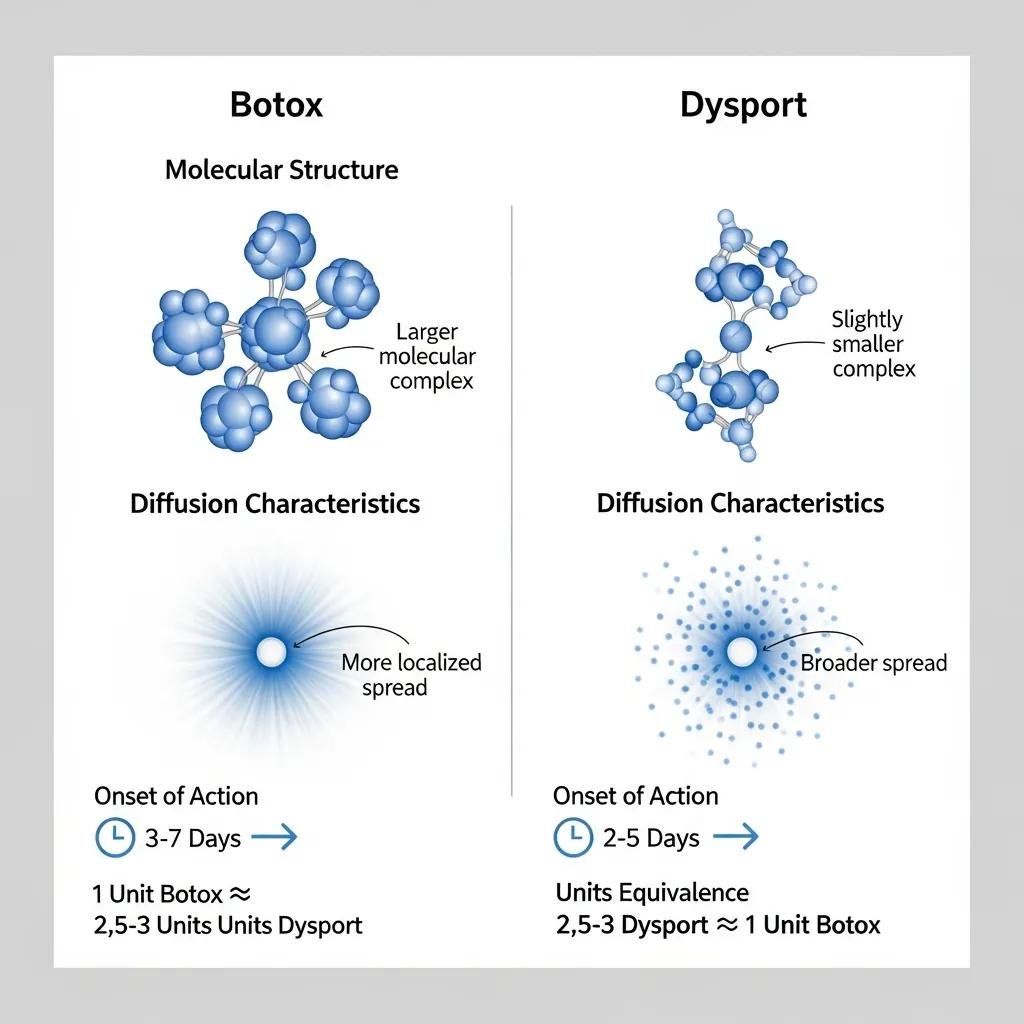
The main difference between Botox and Dysport lies in their active molecules (OnabotulinumtoxinA vs AbobotulinumtoxinA), formulation-related diffusion, and practical dosing ratios — differences that influence precision, onset, and overall planning. In brief: Botox tends to act more locally and is often chosen for precision work, Dysport may onset faster and spread wider which can be useful for larger regions, and dosing between products is not one-to-one so unit conversion and injector experience are crucial. The table below summarizes clinical attributes that matter most in a neurotoxin comparison and supports rapid, evidence-informed decision-making.
Key clinical differences at a glance:
- Botox: localized precision, predictable dosing, often preferred where limited spread is essential.
- Dysport: faster onset and wider spread in some patients, useful for covering larger muscles with fewer injection points.
- Both: effective for glabellar lines, crow’s feet, and forehead lines when dosed appropriately.
| Product | Characteristic | Clinical Implication |
|---|---|---|
| Botox (OnabotulinumtoxinA) | More localized diffusion | Better for precise shaping and small muscles |
| Dysport (AbobotulinumtoxinA) | Smaller complex, greater spread | Suit broader forehead coverage with fewer injections |
| Both products | Neuromuscular blockade mechanism | Reduce dynamic wrinkles by inhibiting acetylcholine release |
This comparison highlights practical trade-offs that help patients and clinicians choose the safest, most effective approach for specific facial anatomy and aesthetic goals.
How Do Molecular Structure and Diffusion Affect Treatment?
Molecular complex size and formulation buffers determine how far a neuromodulator spreads from the injection site, which in turn affects precision, safety, and the number of injection points required. Botox’s formulation typically results in more predictable, localized effects, so it is often used where fine control over muscle weakening is needed to avoid unwanted eyebrow or eyelid changes. Dysport’s relative propensity for wider diffusion can be an advantage when treating broad horizontal forehead lines or large muscle groups because it covers more area per injection. Clinicians weigh these diffusion properties against patient anatomy to strike a balance between coverage and precision.
Understanding diffusion leads directly into expectations for onset and how long results typically last, which informs scheduling and follow-up.
What Are the Onset and Duration of Results for Each?
Dysport often demonstrates clinical effect earlier, with many patients noticing improvement within 2–3 days, while Botox commonly shows visible changes by day 3–5; both reach near-peak effect by two weeks in typical cases. Duration for both agents commonly ranges from about three to four months depending on dose, treated muscle mass, and individual metabolism, with some patients experiencing longer persistence after optimized dosing. Individual variability means follow-up at two weeks for touch-ups or dose adjustments is standard clinical practice to achieve balanced outcomes and maintain natural movement.
These timing differences inform practical scheduling choices for events and maintenance planning when selecting between products.
Which Neurotoxin is Best for Specific Wrinkle Areas?
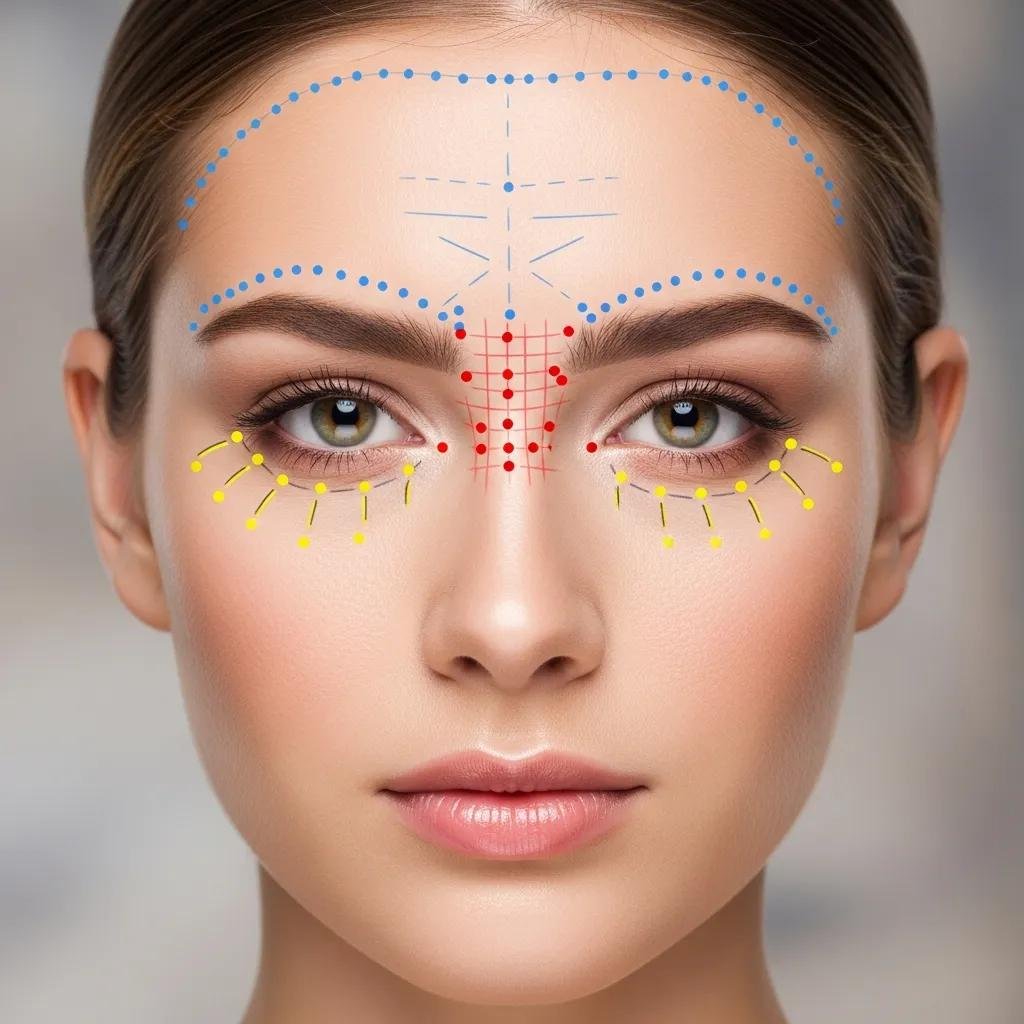
Choosing the optimal neuromodulator depends on the target area, desired precision, and whether broader diffusion is helpful or risky near sensitive structures. For forehead lines, broader coverage can be desirable; for glabellar frown lines, either product works but dosing and injection pattern are key; for crow’s feet, precision is paramount to avoid eyelid or eyebrow changes. The table below gives quick area-specific guidance and clinical rationale to help patients and clinicians decide which product often suits each zone best.
Below is an area-by-area reference to guide selection and discussion with your injector.
| Treatment Area | Preferred Neurotoxin (typical) | Rationale/Notes |
|---|---|---|
| Forehead lines | Dysport (often) | Wider diffusion covers large frontal muscle efficiently |
| Glabellar (frown) lines | Botox or Dysport | Both effective; dosing and pattern determine eyebrow position |
| Crow’s feet | Botox (often) | Localized control reduces risk near the eyelid and orbicularis oculi |
This practical matrix helps frame choices, but injector experience and individualized anatomy ultimately determine the optimal product and plan.
When considering each area, clinicians at Shore MedSpa & Bio Aesthetics apply tailored injection patterns honed for forehead, glabellar, and periorbital treatments in Rockville to achieve balanced, natural results.
Is Botox or Dysport Better for Forehead Lines?
For forehead lines, Dysport is often favored when broader, uniform softening of horizontal lines is desired because its diffusion can reduce the number of injections needed across the frontalis muscle. Botox may be selected when more localized shaping is important — for example when preserving specific eyebrow dynamics or when the frontal muscle is weaker and precision avoids unwanted droop. Injector technique, including dilution, injection depth, and point placement, is critical to achieving an even, natural forehead result regardless of product. An individualized assessment, including discussion of aesthetic goals and baseline eyebrow position, guides the final product choice.
Shore MedSpa’s Rockville injectors routinely evaluate forehead anatomy to recommend the product and dosing strategy that best preserves natural movement while smoothing lines.
How Do Botox and Dysport Compare for Frown Lines and Crow's Feet?
Glabellar frown lines respond well to either product when dosed to relax the corrugator and procerus muscles without over-weakening surrounding muscles; precise patterning prevents undesirable changes in brow shape. Crow’s feet require careful placement because the orbicularis oculi lies close to the eyelid; many injectors prefer the more localized action of Botox to minimize diffusion risks and preserve eyelid function. Safety considerations — including conservative dosing and follow-up assessment of eyelid/eyebrow position — are essential regardless of product to ensure natural expression and minimize complications. Discussing prior responses to neuromodulators and any asymmetries helps the injector determine exact dosing and product choice.
Shore MedSpa’s experience treating these areas in Rockville includes attention to safety and natural outcomes, with follow-up visits to refine results when needed.
How to Choose Between Botox and Dysport in Rockville?
Choosing between Botox and Dysport starts with three practical factors: the aesthetic goal (precision vs broader coverage), timing needs (onset and scheduling), and personal response history to neuromodulators. Assessing muscle strength, facial anatomy, and event timelines helps determine whether a faster-onset or more localized product is preferable. Cost considerations also matter, but unit conversion and total-dose calculations — rather than per-unit price alone — determine final treatment cost. A short checklist below can help patients prepare for an informed consultation and align expectations before treatment.
Use this checklist to frame your consultation and prepare questions for your injector.
- Identify primary goal: Decide whether you want broad smoothing or sculpted, precise shaping.
- Consider timing: Choose Dysport for potentially quicker onset or Botox if you prefer a slightly slower, more controlled onset.
- Review prior responses: Share any history of neuromodulator treatments and outcomes with your injector.
What Factors Should Influence Your Choice?
Factors that should influence product selection include the desired amount of muscle relaxation, the need for rapid visible improvement, prior treatment history, and tolerance for maintenance frequency. Cost plays a role, but because Dysport and Botox use different unit systems — and Dysport often requires a higher unit count with an approximate conversion ratio of 2.5 to 3 units of Dysport per 1 unit of Botox — per-unit price comparisons can be misleading without calculating the total effective dose. Lifestyle factors, such as upcoming events, and medical history that affects neuromuscular function also influence dosing decisions. The best first step is an in-person assessment to map muscle patterns, test natural movement, and agree on a conservative plan that can be adjusted at follow-up.
A structured consultation clarifies these variables and sets realistic expectations before any injection is performed.
Why Consult a Board-Certified Dermatologist at Shore MedSpa?
Consulting a board-certified dermatologist like Dr. Ronald Shore ensures a medically informed assessment of facial anatomy, individualized dosing, and safety protocols that minimize risk while maximizing natural results. Shore MedSpa & Bio Aesthetics emphasizes personalized treatment plans, board-certified expertise, advanced injection techniques, transparent pricing, and local convenience for Rockville patients seeking neuromodulator treatments. An in-person evaluation at the Rockville location allows the clinician to observe dynamic movement, recommend Botox or Dysport based on anatomy and goals, and schedule an appropriate follow-up to refine results. To determine which neurotoxin is right for you, request an in-person evaluation with Dr. Ronald Shore at Shore MedSpa & Bio Aesthetics so the team can create a treatment plan tailored to your needs.
- Medical oversight: Board-certified assessment reduces complication risk and optimizes outcomes.
- Personalized plans: Treatments are adjusted to muscle patterns and aesthetic objectives.
- Local follow-up: Convenient Rockville access supports timely touch-ups and monitoring.
These points explain why clinician expertise and follow-up care are essential parts of safe, effective neuromodulator therapy in Rockville.