AI in Medical Aesthetics: How Artificial Intelligence is Shaping the Future of Personalized Med Spa Treatments
Artificial intelligence in medical aesthetics refers to computer vision, machine learning, and predictive analytics applied to skin imaging and treatment planning to deliver more precise, personalized med spa care. By combining high-resolution image capture with trained models that recognize patterns in texture, pigmentation, and anatomy, AI systems produce objective measurements that help clinicians predict outcomes and tailor interventions. This article explains how AI-powered skin analysis, treatment planning, and patient-facing tools change diagnostic precision, personalize Botox and filler strategies, and improve the overall patient experience in med spas. Readers will learn which AI technologies are commonly used, what measurable skin parameters AI evaluates, how AI-driven recommendations fit into clinician workflows, and examples of patient-facing AI tools such as virtual consults and chatbots. Throughout, the piece integrates practical examples of how a local practice led by a board-certified dermatologist — Shore MedSpa & Bio Aesthetics in Rockville, MD — could adopt these capabilities while keeping clinician oversight central to safety and results.
What is AI in Med Spa Personalization and Why Does It Matter?
AI in med spa personalization is the application of artificial intelligence—computer vision and predictive modeling—to analyze patient data and recommend individualized aesthetic plans, improving consistency and outcomes. The mechanism typically involves image capture, model inference, and quantified outputs that reveal subtle changes invisible to the naked eye; the primary benefit is more accurate baseline assessment and tailored protocols. This matters because personal variation in skin type, anatomy, and lifestyle drives different responses to injectables, lasers, and resurfacing, and AI reduces guesswork for clinicians. The section below describes how AI enhances personalization in practical workflows and which technologies enable those gains.
AI enhances personalization by aggregating images, medical history, and lifestyle inputs into actionable recommendations that clinicians review and adapt. The next subsection illustrates a concise clinician + AI workflow for personalized treatment.
How Does AI Enhance Personalized Med Spa Treatments?

AI personalizes treatments by analyzing patient-specific inputs (photos, movement, prior results) to suggest targeted protocols and predicted outcomes that the clinician verifies before treatment. Models detect anatomical patterns—such as muscle dynamics for neuromodulators or volume loss for fillers—and provide placement or parameter suggestions that improve symmetry and longevity. Clinicians retain decision authority, using AI outputs as quantified guidance to refine dose, sequence, and adjunctive procedures. This collaborative workflow shortens consult time and supports consistent care paths while preserving individualized clinician judgment.
Which AI Technologies Are Used in Medical Aesthetics?
Several core AI technologies power modern med spa personalization: computer vision for imaging and lesion/pigment mapping, machine learning for pattern recognition and outcome prediction, deep learning for complex feature extraction, and augmented reality (AR) for virtual try-on and patient education. Computer vision captures and normalizes photos across lighting and angles, enabling repeatable comparisons. Machine learning models trained on annotated datasets forecast response probability and help prioritize treatment sequences. AR overlays predicted outcomes on live images to align expectations before intervention.
How Does AI-Powered Skin Analysis Improve Diagnostic Precision?
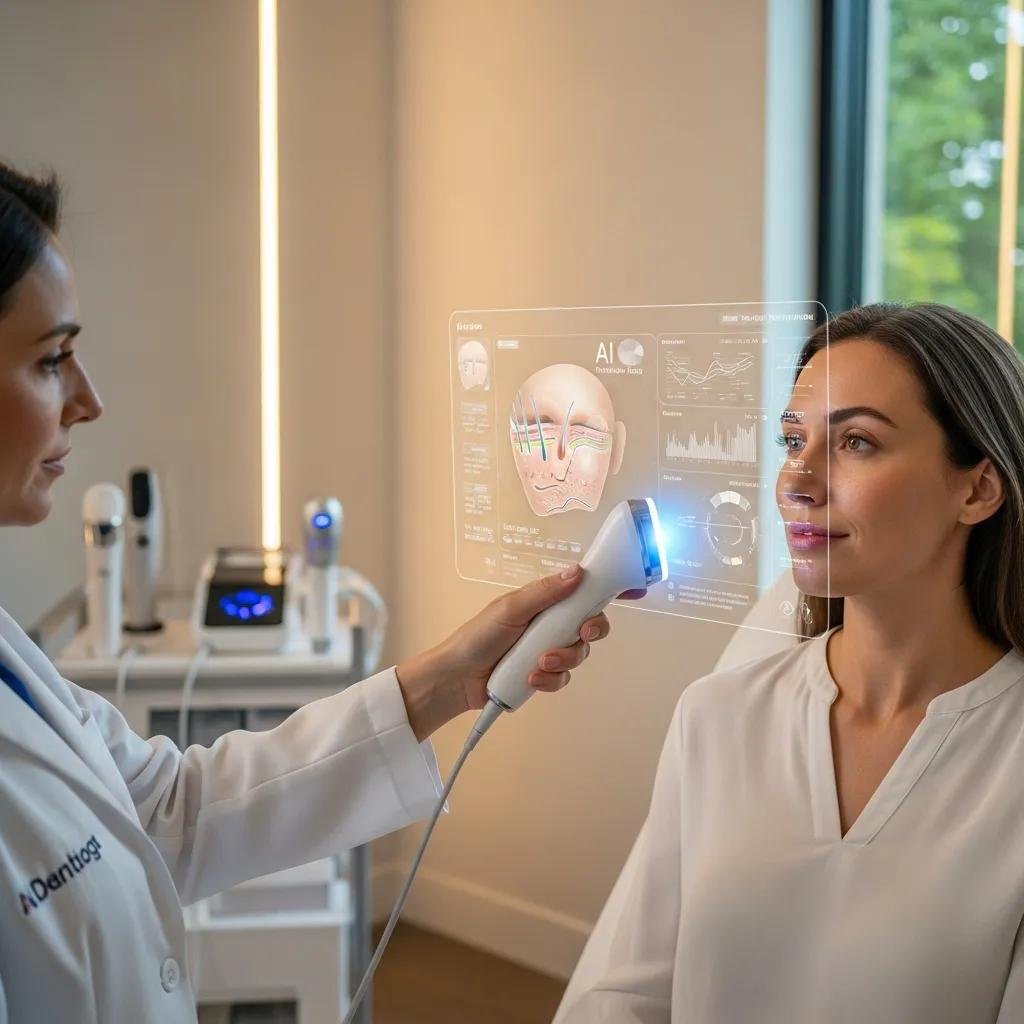
AI-powered skin analysis improves diagnostic precision by quantifying texture, pigmentation, vascularity, and hydration from standardized images to produce reproducible metrics clinicians can track over time. The mechanism is automated image segmentation and feature scoring, which reduces inter-observer variability and detects subtle early changes that inform treatment timing. Benefits include objective baselines for measuring progress, earlier detection of concerns, and data-driven selection of modalities such as chemical peels, lasers, or topical regimens. Below is a concise comparison of common diagnostic attributes AI evaluates and their typical precision advantages.
AI systems evaluate multiple skin parameters and generate scores that clinicians use to guide therapy and monitor outcomes, as summarized next.
| Skin Attribute | What AI Measures | Practical Value |
|---|---|---|
| Texture & Wrinkles | Depth/volume indices from 3D or multi-angle images | Objective tracking of resurfacing or microneedling efficacy |
| Pigmentation | Area, intensity, and distribution maps | Targeted selection of lasers or peel strength |
| Vascularity/Redness | Red channel quantification and pattern detection | Guides vascular laser parameters and pre/post-care |
| Hydration & Porphyrins | Reflectance metrics and fluorescence proxies | Informs topical therapy and downtime expectations |
What Parameters Does AI Evaluate in Skin Analysis?
AI evaluates wrinkle depth, fine-line distribution, pigmentation severity and mapping, vascular patterns, porphyrin presence, and hydration indices by combining spectral imaging and texture analysis into numeric scores. Each parameter corresponds to clinical decisions: for example, quantified pigmentation maps determine whether pigment-targeting lasers or chemical peels are preferable. AI measurement consistency enables meaningful before-and-after comparisons and refines maintenance schedules. These objective metrics help clinicians prioritize interventions with clearer expected benefits for each patient.
How Does AI Compare to Traditional Skin Diagnostic Methods?
Compared with traditional visual exams, AI delivers quantitative, reproducible assessments with faster turnaround and reduced inter-observer variability, though it requires curated datasets and clinician interpretation to avoid bias.
Traditional methods rely on qualitative scales and clinician experience that can vary between providers; AI supplies consistent scoring across visits, improving monitoring precision. Limitations include dependency on high-quality imaging, potential dataset biases, and the continuing need for clinician oversight to contextualize findings. Understanding these trade-offs informs safe adoption of AI-guided diagnostics in practice.
For a local example of adoption, Shore MedSpa & Bio Aesthetics — led by board-certified dermatologist Dr. Ronald Shore in Rockville, MD — could integrate AI imaging to enhance existing services like chemical peels and laser therapies. Such AI-augmented diagnostics would provide objective baselines and progress tracking that complement Shore MedSpa’s emphasis on personalized treatment plans and advanced technology.
In What Ways Does AI Drive Personalized Treatment Planning?
AI drives personalized treatment planning by translating diagnostic data into prioritized recommendations and optimized sequences that forecast outcomes and resource needs. The core steps are data intake, model analysis, and clinician-reviewed recommendations; this streamlines complex decision-making while maintaining safety checks. Predictive modeling helps forecast longevity of fillers or expected wrinkle reduction with neuromodulators, allowing clinicians to propose maintenance intervals and multimodal combinations. The following numbered workflow shows how AI integrates into planning for actionable steps.
- Data Intake: Collect standardized images, history, and goals.
- Analysis: AI quantifies features and predicts likely responses.
- Recommendation: System proposes dosing/placement or device settings.
- Clinician Review: Provider adapts plan for safety, aesthetics, and patient preference.
This workflow ensures AI informs but does not replace clinical judgment; the next subsection maps specific treatments to AI-informed attributes in a concise EAV-style table.
| Treatment | AI-Informed Attribute | Example Output |
|---|---|---|
| Botox (neuromodulator) | Muscle movement mapping | Suggested injection points and relative dosing |
| Dermal Fillers | Volume loss and symmetry metrics | Predicted filler volume and placement for balance |
| Laser Therapies | Pigmentation and vascular scores | Recommended wavelength and fluence ranges |
How Does AI Tailor Botox, Fillers, and Laser Treatments?
AI tailors injectables by mapping dynamic facial movement and static volume deficits to suggest targeted placement and relative dosing that aim to maximize symmetry and natural expression. For fillers, predictive shape modeling estimates volumetric needs and visualizes outcomes to reduce trial-and-error. For lasers, quantified pigment and vascular indices inform wavelength selection and energy settings to optimize efficacy while minimizing risk. Clinicians review AI recommendations and integrate anatomy, safety considerations, and patient goals before proceeding.
What Are the Benefits of AI-Driven Treatment Plans?
AI-driven plans improve predictability, reduce unnecessary sessions, and increase patient satisfaction by aligning interventions with measurable skin features and outcome forecasts. Clinically, this can mean fewer corrective procedures and more efficient use of devices and injectables. From a patient perspective, clearer visualizations and data-backed timelines set realistic expectations and improve consent quality. These benefits support safer, more efficient workflows and better long-term maintenance strategies.
For practices like Shore MedSpa & Bio Aesthetics, emphasizing board-certified leadership and customizable plans, AI-assisted planning provides an added layer of data-driven confidence while preserving physician-led decision-making.
How is AI Enhancing the Patient Experience in Med Spas?

AI enhances the patient experience through virtual consultations, AR visualizations, and chatbots that streamline intake, education, and scheduling, improving access and transparency. Mechanisms include 24/7 chatbot triage, AR outcome previews to align expectations, and automated progress reports that keep patients engaged between visits. These tools reduce administrative friction and empower patients with understandable visual data that supports informed consent. The next subsections describe common patient-facing tools and compare their attributes.
| Tool | Availability | Data Captured | Patient Benefit |
|---|---|---|---|
| Chatbot/Triage | 24/7 messaging | Symptom checklist, basic history | Faster scheduling and pre-screening |
| Virtual Consultation (tele-AR) | On-demand | Photos, live video, AR overlays | Informed decisions with simulated outcomes |
| AR Try-On | Session-based | Facial landmarks, predicted post-treatment image | Sets realistic expectations visually |
What Role Do AI Chatbots and Virtual Consultations Play?
AI chatbots and virtual consultations handle routine education, intake, and triage tasks so clinicians can focus on higher-complexity care; they collect photos, symptom checklists, and preference data ahead of visits. Chatbots reduce administrative burden by answering common questions and handling appointment logistics, while virtual consults enable early alignment on goals and candidacy. Both require seamless clinician handoff for medical decisions and safety screening. When combined with in-clinic AI imaging, these tools create an end-to-end patient journey from first contact to post-treatment monitoring.
How Does AI Improve Transparency and Patient Education?
AI improves transparency by generating visual outcome simulations, objective baseline-to-outcome metrics, and tailored educational content that clarifies likely benefits and trade-offs for each intervention. Visualizations help align expectations, while quantified progress measures demonstrate treatment effectiveness over time. Clinicians use these AI-generated artifacts to support informed consent and shared decision-making, ensuring patients understand realistic outcomes and maintenance needs before committing to procedures. For patients, clearer information fosters trust and satisfaction with their aesthetic journey.